
The Flash Memory Summit (FMS) 2022 is in full swing, so we thought we’d take a moment to share some of what’s happening in Santa Clara this week.
First, we’re showing two demos of our ReRAM technology in our booth. The first shows the real-world capability of Weebit ReRAM as a non-volatile memory (NVM) integrated into an actual subsystem, and also highlights the faster write speed of the Weebit ReRAM module compared to typical flash memory. The second demo shows how using neuromorphic techniques based on ReRAM greatly increases parallel connectivity and significantly improves energy efficiency compared to traditional computing approaches.
As you can see from the picture, we’re seeing a great deal of interest in the demos.

In addition, our VP of Tech Development, Amir Regev, just presented some new test results during his session, “ReRAM’s Development Path Towards Commercialization.”
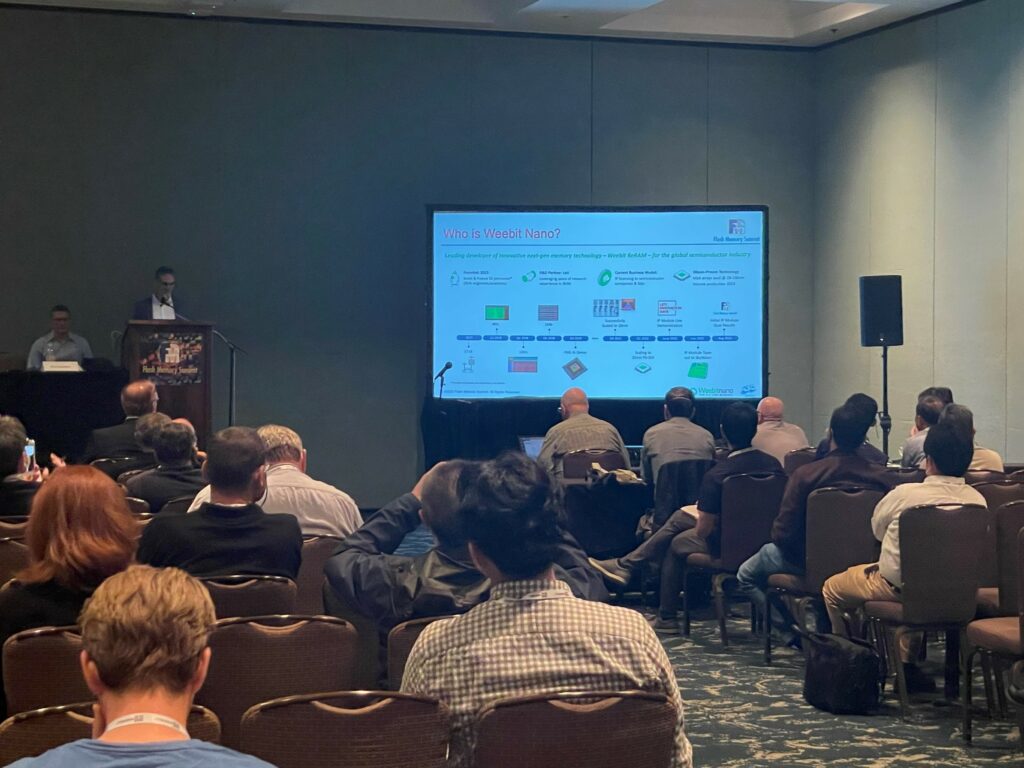
These test results are part of the qualification process, a requirement for products like NVM. As you may know from our previous blog on the topic of qualification, it is a long and intensive process by which we ensure a design is ready for production, confirming it meets commercial specifications and will continue to do so over the expected lifetime of the product. The idea is to test many instances of the product from different manufacturing lots, and do so in an accelerated manner. In this way we can simulate the possible effects of environmental factors over a product’s expected lifetime.
This qualification process is based on our demo chip which includes our embedded ReRAM module, unlike previous results that have been based on R&D tests of our memory array. The demo chip – which we recently demonstrated publicly for the first time (and are now showing at FMS) includes the ReRAM array as well as control logic, decoders, IOs (Input/Output communication elements) and error correcting code (ECC) as well as patent-pending analog and digital smart circuitry – implemented in actual silicon in 130nm.
Qualification is a gradual process, whereby test conditions are continuously intensified, pushing a product’s boundaries to spec and beyond. For example, we begin testing the ReRAM module at room temperature, and steadily increase the temperature over time.
We are putting the module through tests that follow industry standards such as NVM tests developed by industry standards body JEDEC. Gathering in-depth statistics with a standards-based approach is critical to showing the maturity of the technology as we approach productization.
The test results Mr. Regev shared at FMS are based on early qualification test results of the demo chips we recently received from Leti, which are better than normally expected at such an early phase. We are delighted with the impressive data retention, endurance and high-temperature stability we see in these initial tests. Qualification of the module is an ongoing process, and we expect to have final qualification results before the end of 2022.
To see Mr. Regev’s presentation from FMS, click here.